
Startup Using the Lean Analytics Cycle
July 23, 2024 – Ben Yoskovitz – Founding Partner at Highline Beta | Author of FocusedChaos.co
I’m a huge Lean Startup fan. The concept of Build -> Measure -> Learn makes a ton of sense to me. A simple, elegant loop where you figure out what to build, measure the results, and learn. You iterate as quickly & frequently as possible to increase the odds of “figuring it all out”.
Unfortunately like most frameworks, it’s oversimplified. When Alistair Croll and I wrote Lean Analytics, we decided to expand on the concept w/ The Lean Analytics Cycle
- Pick the One Metric That Matters and Draw a Line
- Decide on the biggest problem you’re facing. Be honest. Focus wins. In my experience most founders KNOW what it is, they just don’t want to admit it or don’t know how to fix it. They mess around on the edges hoping for a miracle.
- Once you know what the biggest problem is you can identify the right metric to track (OMTM).
- Find a Potential Improvement & Write a Hypothesis
- Bring the whole team together for an ideation session. I’ll share how to do this in the comments. The top problem at your company is EVERYONE’s problem. So get ’em aligned.
- You can also look at data. What are your best users doing compared to those that churn? What commonalities exist amongst your best users? Data can drive hypotheses.
- Quickly prioritize the top 1-3 ideas based on value vs effort. Then write assumptions. Literally. Write them down. So many startups skip this step & do not get the team aligned or forget what they’re focusing on and why.
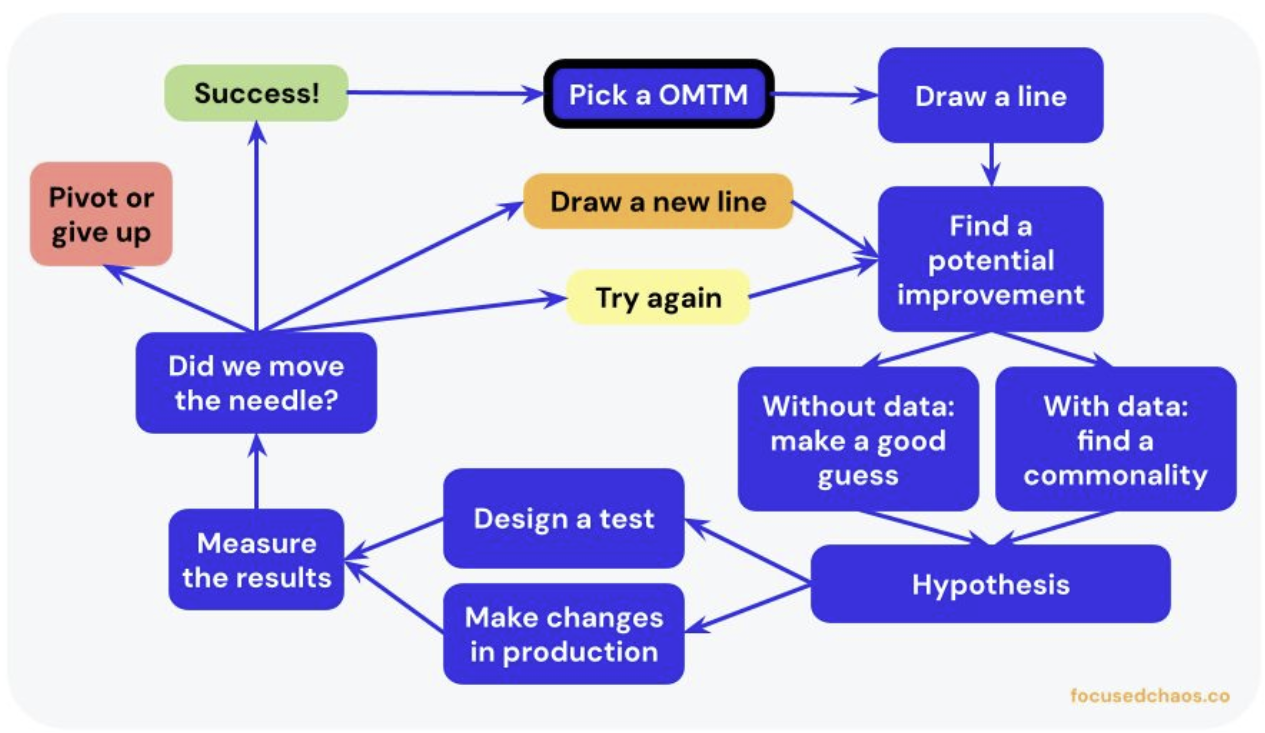
- Design a Test
- Now run a test. Could be small. Maybe it’s not even adding a new feature. Try taking a feature out! Or changing a process. Deploy something to half your users. Run a fake door test. Or f**k it ship it and build something new and launch.
- No test should take longer than 2 weeks to develop. If it does, your team should immediately question whether things can be done faster/better. Some things take longer, but recognize the risk in a longer cycle/learning time.
- Analysis paralysis is the enemy. Doing something is better (most of the time) than nothing. In the absence of data, use your gut.
- Measure the Results
- Did your test move the needle?
- Maybe the test failed. You can give up, try again, or pivot. A failed test is still LEARNING.
- Chances are the test worked, but maybe not well enough. In that case, test again and again. You’re probably running multiple simultaneous tests; this makes it tougher to know what worked, but startups aren’t built in labs.
- Eventually, tests drive diminishing returns. Going from 10% to 7% churn might be easy, 7% to 6% is tougher, 6% to 5% harder still. If you get to 5.5%, maybe you stop and draw a new line. Focus on something else. Going from 5.5% to 5% may be too costly and not worth it for the stage you’re at.
➡ Whenever you focus on one thing, it generally tells you where to focus next. If you reduce churn enough, it’s time to go to the top of the funnel and get more leads. It’s a fairly logical process in an insanely chaotic one (building a startup).
Frequently asked questions
What is the Lean Analytics Cycle?
The Lean Analytics Cycle is an expanded version of the Lean Startup Build-Measure-Learn loop, created by Ben Yoskovitz and Alistair Croll. It has four steps: pick the One Metric That Matters, find an improvement and write a hypothesis, design a test, and measure the results. Each cycle points to the next problem to focus on.
What is the One Metric That Matters (OMTM)?
The OMTM is the single metric that best tracks your biggest current problem. You identify the problem first, then choose the metric, so the whole team focuses on one thing instead of working around the edges. When you have improved it enough, you draw a new line and pick a new metric.
How long should a startup experiment take?
According to this article, no test should take longer than two weeks to develop. If it does, ask whether the work can be done faster or better. Some tests take longer, but a longer cycle means slower learning and more risk.
What kinds of tests can an early-stage startup run?
Tests can be small and do not have to add a feature. You can remove a feature, change a process, deploy a change to half your users, run a fake door test, or ship something new. Even a failed test produces learning.
When should a startup stop optimizing one metric?
Stop when the next improvement costs more than it is worth at your stage. The article's example is churn: moving from 10% to 7% may be easy, but each further point gets harder, so you might stop at 5.5% and focus elsewhere, such as top-of-funnel leads.
Written by
Articles from the team behind DealIQ™, TeamDNA™ and ROI Waterfall®.